
How to Use Informational Interviews to Avoid Unnecessary Career Mistakes
This simple art of asking is what you need in your career arsenal for 2025

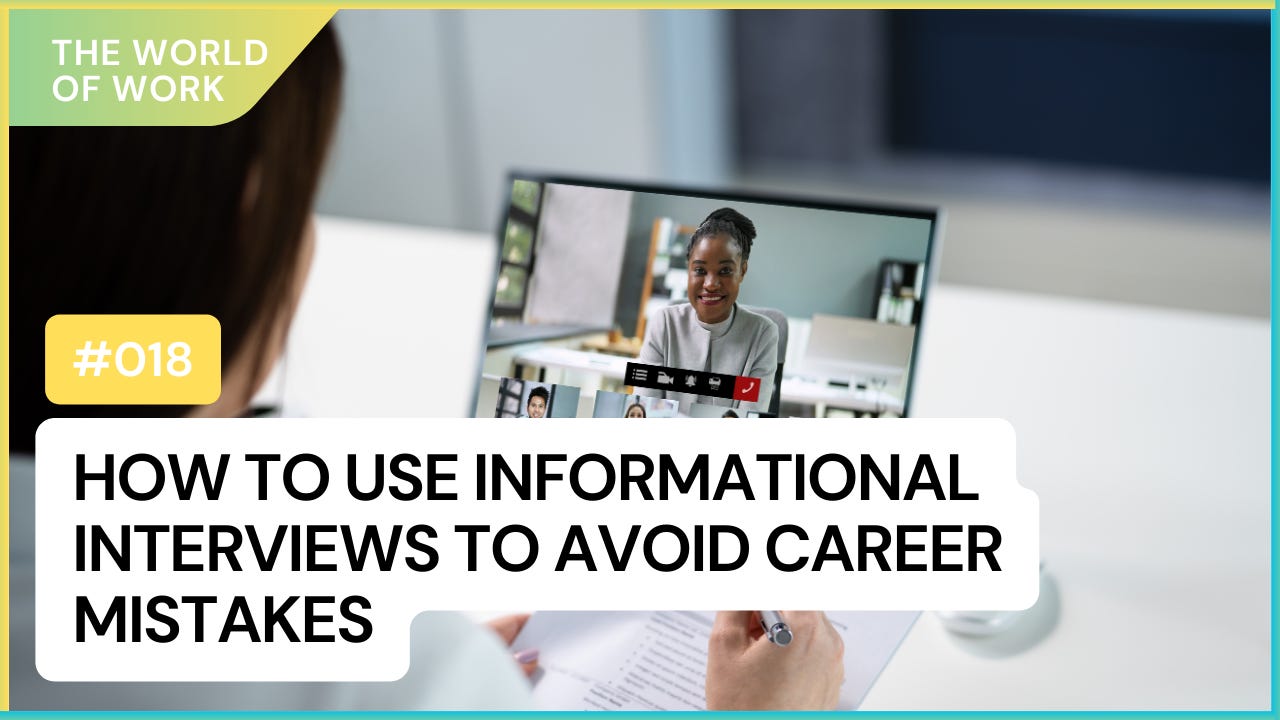
If there’s one thing I’ve learned, it’s that most career mistakes are avoidable —not by guessing your way through, but by tapping into the experiences of those who’ve walked the path before you. There’s no prize for struggling through what someone else could have helped you sidestep in five minutes.
This is where informational interviews come in.
I know, the phrase makes it sound like some formal, high-stakes thing. But it’s basically a casual, structured conversation with someone who has the experience or career path you’re curious about. It’s not a job interview. You’re not asking for a job. You’re asking for insight — what works, what doesn’t, and what they wish they had known earlier.
And trust me, most people are more willing to share their experiences than you think.
In 2024 alone, I conducted 30+ informational interviews while trying to get clarity on my career path. I also regularly get on quick 15-minute chats with some of my new LinkedIn connections whose work or past experiences intrigue me. And let me tell you — these conversations have done more for my career than any Google search or YouTube video ever could.
I used to think career clarity was something you figured out alone, through deep reflection and trial-and-error. But the truth is, most of the answers you need are already out there, living in someone else’s experience. You just have to ask the right people the right questions.
So, let’s get into it: How do you actually conduct an informational interview, and more importantly, how do you make it worth their time and yours?
Step 1: Know What You Want to Learn
Before reaching out to anyone, be clear on your goal. Are you:
Exploring a new career path and want to know what the job actually looks like?
Trying to gauge company culture before applying?
Learning how to transition into a new industry without starting from scratch?
Curious about someone’s career moves and how they made decisions at key points?
Your questions should be based on what will genuinely help you — not just what sounds impressive.
Step 2: Find the Right People
Not every successful person is the right person to talk to. The best people for informational interviews are:
Those currently doing what you want to do (not just those who did it 15 years ago when things were different).
People one or two steps ahead of you — they remember the struggles of your stage and can give practical insights. (Don’t go for people who are ridiculously high up, you’ll mostly get aired).
Individuals with similar backgrounds, interests, or values — relatability makes for a more honest conversation.
I usually find these people on LinkedIn, Twitter (sorry, X), niched communities, or through mutual connections. Experts will tell you a warm introduction always works better than a cold message, but the truth is a well-crafted cold message can still work.
In fact, I’ve only had a few instances where someone made me a warm introduction. Every other connection? Cold messages. And I get responses almost every time. By the way, don’t take it personally if you don’t get a response. Some people are busy, so follow-up once and move on to the next person.
Step 3: Craft a Strong (but Not Overwhelming) Ask
Keep it short, please. No long, rambling messages. And while you’re at it, make it clear you’re not asking for a job. You just want to learn from their experience.
BAD ASK:
"Hi, I admire your work. Can I pick your brain sometime?"
(Translation: I have no real question, and I might waste your time.)
GOOD ASK:
"Hi [Name], I came across your profile while researching [field] and really admire your experience in [specific role]. I’d love to hear about your journey into [industry] and what you wish you knew before starting. Would you be open to a 20-minute chat? I’ll keep it brief and work around your schedule."
(Bonus point: If they’re African and appear older, ADD appellation!)
Step 4: Make the Conversation Worthwhile
Once they say yes, respect their time:
Do your research. Don’t ask them things you could easily Google.
Have a few great non-generic questions ready. Let’s categorize them into:
Breaking the ice (but with purpose):
I came across your [specific project, article, or role], and it really caught my attention. Can you tell me the backstory of how you got into that?
If you were starting in this field today, what’s one thing you’d do differently?
What’s a misconception people have about your role/industry that you wish more people understood?
Getting the real career insights:
What’s a misconception people have about your role/industry that you wish more people understood?
What skills or knowledge gaps do you see holding early-career professionals back in this space?
Can you walk me through a typical workday or week for you? What parts are exciting, and what parts are... not so much?
Lessons from their journey:
Looking back, what were some pivotal moments that shaped your career direction?
What’s a mistake you made early on that taught you a lot?
If you had just 6 months to break into this field from scratch, how would you go about it?
Understanding career growth & trends:
What’s changing in this field that people entering now should prepare for?
Are there any hidden career paths in this industry that aren’t talked about enough?
What kind of opportunities should I be actively looking for to accelerate my learning?
Make it personal:
Based on what we’ve discussed, is there anyone else you think I should speak with? (Best way to get a warm introduction!)
If you were in my shoes, what would you focus on for the next 6 months?
Let them talk more than you do. Your job is to listen and take notes.
Be mindful of time. If you asked for 20 minutes, wrap up at 19:30 (unless they want to keep going).
Step 5: Follow Up Like a Decent Human
The interview isn’t over just because the call ends. Send a follow-up message the same day or the next, thanking them and mentioning something specific you learned.
Example:
"Thanks so much, [Name]! I really appreciate you sharing how [specific insight] helped you in [field]. I’ll be applying that immediately. Hope to stay in touch!"
And if they gave you advice on something actionable? Follow up later to share how it helped you. It keeps the relationship warm and makes them more likely to help you again in the future.
Why This Matters
I’ve been on many career consultations and seen firsthand who people struggle for years with things they could have figured out in a single 30-minute conversation with the right person.
Stop doing guesswork and hoping for the best with your career. Growth is about leveraging knowledge, learning from mistakes (preferably not your own), and making intentional decisions.
So if you’ve been sitting on career questions, waiting for divine intervention —here’s your sign: Ask someone who’s been there.
What Would Olufolake Do?
Just here to remind you that you can always drop me a question or share a career dilemma for the What Would Olufolake Do? column. In each issue, I’ll dive into a new scenario, offering my perspective as if I were right there in your shoes. And rest assured, your questions remain anonymous! So feel free to share what’s on your mind, and let’s work through it together.
Some navigating the ‘World of Work’ resources
Opportunity: If you’re based in Nigeria and would like to involve yourself in some stretch volunteer projects, Boys Quarters Africa (BQA) is definitely the place for you. BQA runs a lot of on-ground projects around the year in different locations across Nigeria. Learn more about the available roles and sign up here.
Found this incredible resource for people in the social impact space. If you’re navigating job search or exploring this space, you’ll find it useful.
Till I write to you again,
Olufolake.